No. 122 · Hospitality / Analysis
The Human Touch Is Becoming a Luxury Product
Automation is making basic hospitality faster and cheaper. The result will not be the disappearance of human service, but its concentration where guests can pay for attention.
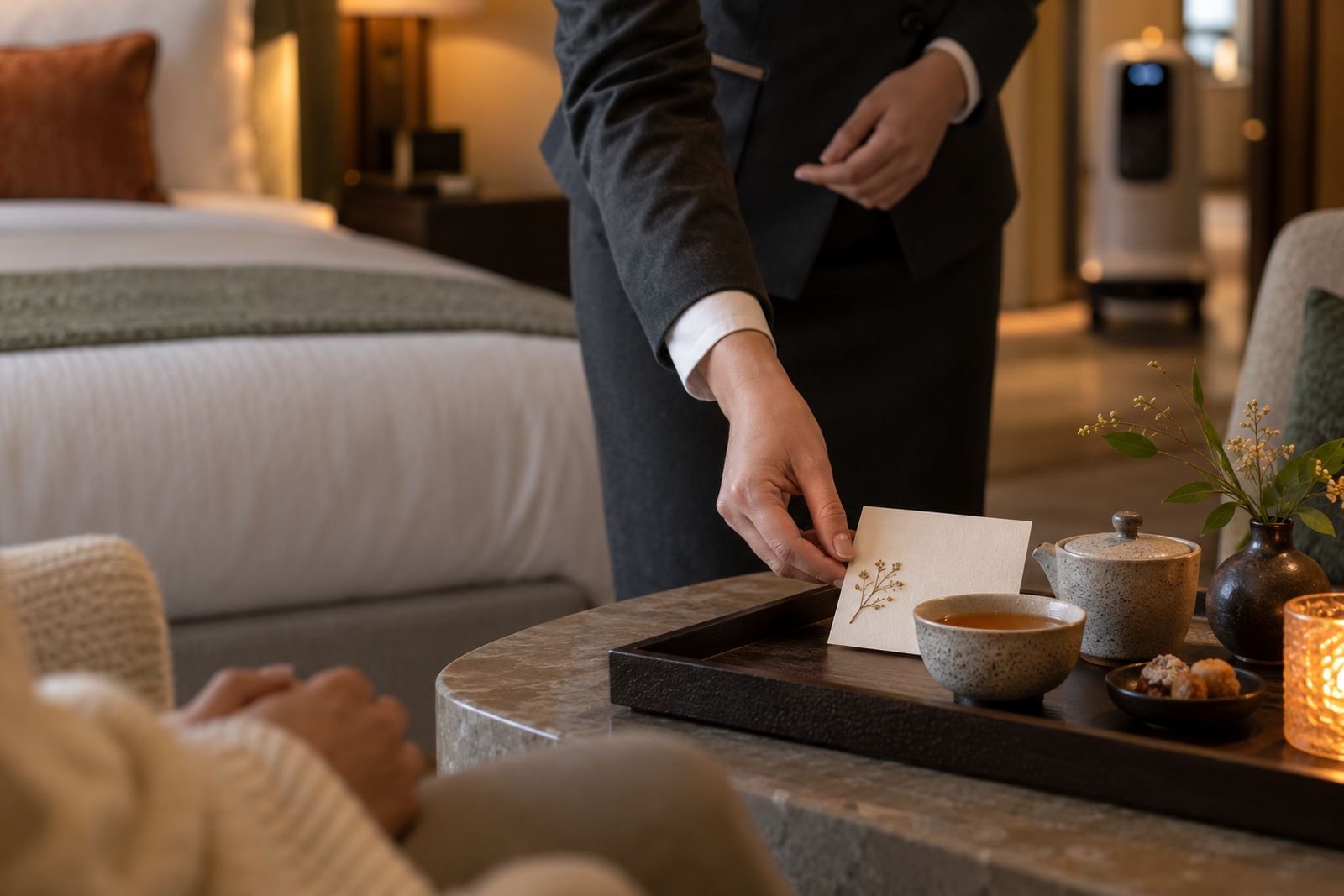
The future hotel may offer two radically different products inside the same industry. In one, the guest books, arrives, enters, requests service and departs without speaking to another person. In the other, people anticipate the guest, interpret ambiguity, remember context and intervene before a problem becomes visible. Both products can be excellent. But only one of them will carry a growing labour premium.
For years, hospitality technology was sold as a way to remove friction. Mobile check-in, digital keys, messaging, kiosks and automated service recovery promised faster transactions and lower operating cost. Guests have shown that they value much of this convenience. In an Oracle and Skift survey of more than 5,000 consumers, 73% agreed they were more likely to stay at a hotel that offers self-service technology to minimise contact with staff and other guests.
That finding is sometimes presented as evidence that guests no longer value people. It says something more precise: many guests do not value waiting for a person to complete a transaction a machine can finish immediately.
Technology does not make human service obsolete. It exposes which human interactions were never valuable enough to require a human.
Convenience is becoming infrastructure
Once mobile entry, instant messaging and automated payment become reliable, they stop differentiating a hotel. They become infrastructure—the expected operating layer. This is already familiar in aviation, banking and retail. The customer does not celebrate the ability to receive a boarding pass or transfer money without an employee. They notice only when the system fails.
Hotels will follow the same path unevenly. Select-service and economy products have the clearest incentive to automate repeatable contact. Their promise is consistency, location and value, not continuous personal attention. Full-service and luxury hotels face a different challenge: technology can remove administrative friction, but the saved labour must reappear as better judgement and presence if the property still expects a service premium.
This is the central commercial shift. Human service is moving from a default operating input to an allocatable product feature.
The scarcity is attention, not headcount
In 2025, US hotel labour cost per occupied room increased 12.8% to $48.32, according to HotelData.com. In the fourth quarter alone, wage cost per occupied room rose 21.1% year over year. Hotels simultaneously worked to reduce or redeploy hours per occupied room. By the first quarter of 2026, according to HotelData.com, the all-hotel average stood at 2.105 labour hours per occupied room—about 126 minutes across all departments.
Those minutes include housekeeping, engineering, management and other work the guest may never see. The amount of direct, discretionary human attention available to a guest is a smaller subset. As wages rise and productivity systems improve, hotels will become more deliberate about where those guest-facing minutes go.
Routine questions will move to messaging. Standard requests will be routed automatically. Check-in will become optional as a human encounter. Staff will be concentrated around exceptions, emotion, complexity and high-value moments: a disrupted arrival, a family milestone, a difficult recovery, an introduction to a city, a preference that was never entered into a profile.
126 min
Average total labour time per occupied room across all hotel departments in Q1 2026, calculated from HotelData.com’s 2.105 hours per occupied room. Only a fraction is guest-facing.
Luxury will sell access to judgement
Luxury hardware is becoming easier to imitate. Better beds, rainfall showers, attractive lobbies and high-quality finishes have travelled down the chain scale. McKinsey has noted that non-luxury properties have closed the gap on some of the physical details that signal luxury, such as sumptuous mattress tops and rainfall showerheads. That weakens hardware as a durable rate fence.
Human judgement is harder to copy. It depends on recruitment, authority, culture, memory and the willingness to carry labour when demand is uneven. A person who can read a room, bend a process and coordinate a recovery across departments is not an amenity. They are an operating capability.
This suggests that the next generation of luxury service will not simply employ more people. It will guarantee access to more consequential attention. The difference may appear through named hosts, private arrival, dedicated concierges, residential-style teams, lower key counts, membership or service ratios protected by design.
The premium is not for conversation itself. Forced interaction can be another form of friction. The premium is for the credible availability of a capable person when context matters.
The risk: a visible two-tier hotel
There is a less comfortable implication. If automation absorbs routine service while human attention becomes a premium benefit, the industry can create an explicit service class system. One guest receives a chatbot and a queue; another receives a person with authority. If both are staying in the same building, the difference will be visible.
This is not entirely new. Hotels already differentiate through club floors, butlers, private concierges and suite benefits. What changes is the baseline. As the standard journey becomes more automated, the contrast between access and non-access grows sharper.
Operators will need to decide which human minimum applies to every guest. Safety, dignity, accessibility and meaningful service recovery cannot become paid upgrades. Automation should remove low-value work, not the possibility of care.
Designing the hybrid service model
01
Automate transactions
Identity, payment, keys, simple requests, confirmations and routine information.
02
Humanise exceptions
Disruption, emotion, ambiguity, recovery and moments with reputational risk.
03
Protect presence
Place capable people where guests can find them without navigating a digital maze.
04
Measure attention
Track guest-facing minutes and outcomes, not headcount or labour cost alone.
The winning model will not be “high tech” or “high touch.” It will be high judgement. Technology should give staff context before contact and eliminate work that contributes nothing to the guest. People should then spend their limited time on interactions where judgement changes the outcome.
For select-service hotels, this can create a cleaner and more reliable product with fewer forced encounters. For luxury hotels, it raises the bar: a high rate will increasingly need to purchase access to attention, not merely more design and more amenities.
The Leisure Economy View
What this means for operators, investors, marketers and destinations.
For operators
Map every guest interaction by complexity and emotional consequence. Automate the repeatable; staff the ambiguous; never hide recovery behind a bot.
For investors
Service capability is an operating asset. Underwrite labour not only as cost per occupied room, but as the capacity that protects rate and reputation.
For marketers
Do not advertise “personalised service” without defining access. The credible promise is who is available, what they can decide and how quickly they can act.
For guests
The future premium may be the ability to reach a competent person without first proving that the machine failed.
Sources and methodology
Oracle Hospitality and Skift, “Hospitality in 2025” consumer research, 1 June 2022. 5,266 consumers surveyed in nine countries.
Research
HotelData.com, Q1 2026 Hotel Labor Costs Report, 11 June 2026. Based on Actabl Hotel Effectiveness data.
Research
Disclosure: the author holds a commercial marketing role within the branded resort sector, including in Mexico. No sponsor, partner or commercial relationship influenced this piece. Every figure cited is drawn from public statements, official statistics or freely published research; no employer, subscription or otherwise non-public data was used. See our sponsorship disclosure.