No. 125 · Hospitality / Analysis
Why Hotels Are Becoming Destinations
The strongest properties are building enough food, culture, wellness and access to become the reason for the trip—not merely the place where it begins and ends.
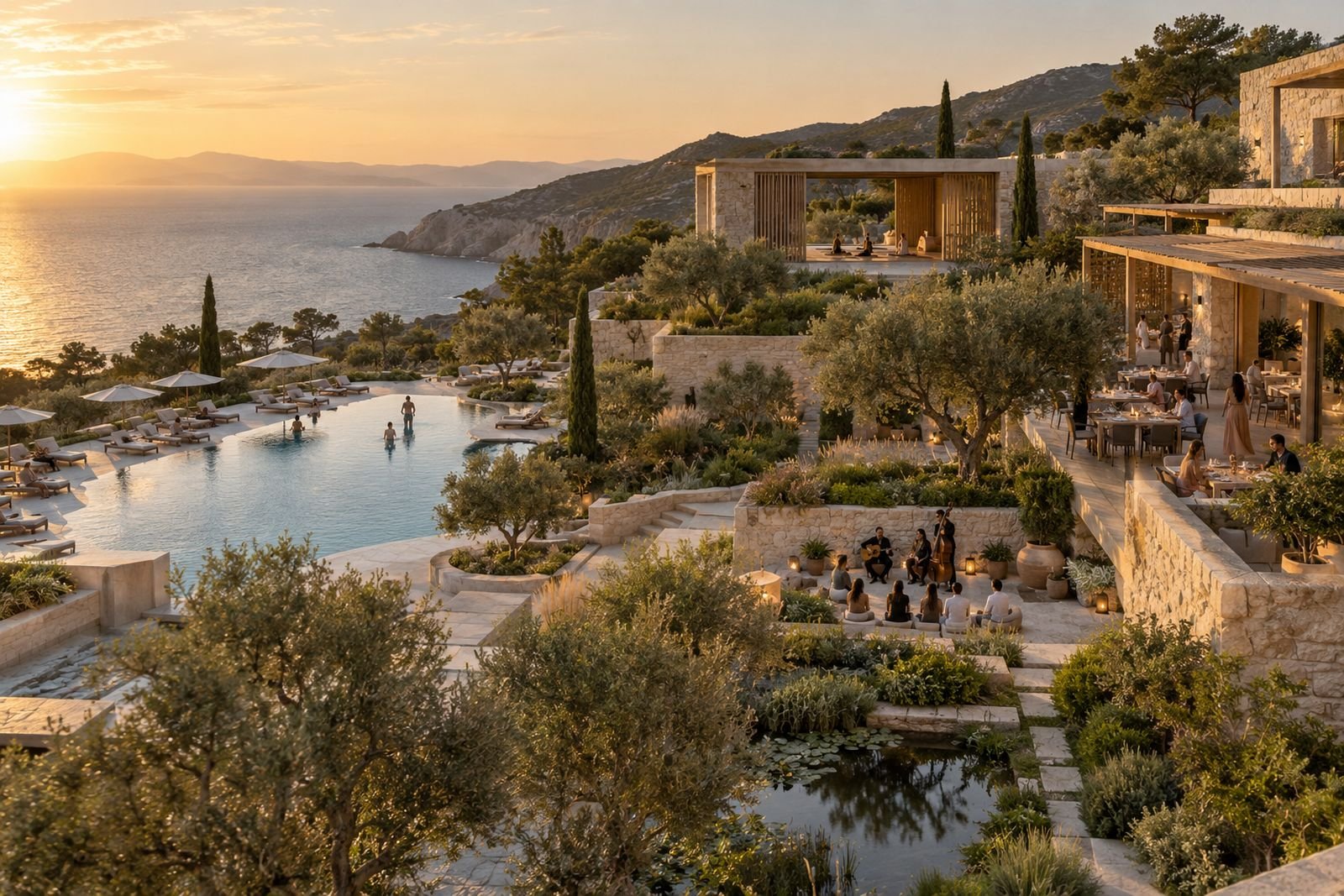
A hotel used to borrow most of its demand from somewhere else. The beach, business district, theme park, historic centre or convention brought the traveller; the hotel captured the overnight stay. That hierarchy is beginning to reverse. A growing class of properties is assembling enough reasons to visit that the hotel itself becomes the trip.
This is visible in obvious forms: destination resorts, wellness retreats, private islands and properties built around golf or skiing. But the model is spreading into cities and secondary markets. Hotels are using restaurants, members’ clubs, cultural programming, retail, branded residences, nightlife and local access to create demand that is not fully dependent on what sits outside the front door.
The commercial logic is straightforward. A property that is merely convenient competes on room, rate and location. A property that creates the itinerary can compete for a larger share of the guest’s time and budget.
The hotel becomes a destination when leaving remains possible but stops being necessary.
Experiences are becoming a value pool
McKinsey describes the global marketplace for travel experiences as a more than $1 trillion opportunity, within a wider tours, attractions and activities market worth more than $3 trillion. Hotels have an unusual position in that market. They already hold the guest relationship, payment method, location and time window. Yet many still treat the room as the product and the experience as an amenity.
That leaves value outside the asset. A guest who sleeps at the hotel but spends the day, dinner and evening elsewhere may generate a strong ADR and a small share of total trip spend. A property that supplies breakfast, wellness, activity, culture, dinner and social life can capture more revenue without adding another occupied room.
The opportunity is not simply to add amenities. Amenities consume capital and operating labour. They become demand engines only when they are distinctive enough to influence the booking decision or extend the stay.
$1T+
The travel-experiences opportunity identified by McKinsey. Hotels can participate as producers, distributors and physical platforms for that spend.
The four systems of a destination hotel
01
Food and social life
Restaurants, bars and gathering spaces that attract locals as well as guests.
02
Wellness and restoration
Spa, movement, nature and protected calm that can motivate a dedicated trip.
03
Culture and programming
Events, artists, chefs, learning and rituals that give the property a changing calendar.
04
Access and curation
Privileged entry to the surrounding place, translated through trusted people and partnerships.
These systems do different jobs. Food creates frequency and local relevance. Wellness supports length of stay and rate. Programming gives guests a reason to return at a different time. Access prevents the property from becoming a closed bubble and turns the surrounding destination into an extension of the hotel product.
The best destination hotels combine all four without forcing guests through a schedule. The product is not constant activity. It is the confidence that something worthwhile is available without the planning burden.
Why the model is expanding now
First, physical hotel quality has converged. Good beds, design, pools and gyms are available across more price points. The room alone has less power to differentiate.
Second, travellers increasingly value experiences, purpose and emotional outcomes. Hilton’s 2026 Trends Report, published in October 2025, frames this as the “whycation”: trips organised around the reason a person needs to travel, from stillness to family connection. A hotel that embodies that reason can intercept demand earlier in the planning process.
Third, digital distribution makes rooms easy to compare and experiences difficult to compare. That asymmetry benefits distinctive properties. A standard room is sorted by price, rating and distance. A compelling programme, community or setting is harder to reduce to a filter.
Fourth, mixed-use economics encourage hotels to support more than transient room revenue. Restaurants, clubs, residences, retail and wellness can diversify cash flow and help a project become relevant to local users. The hotel shifts from accommodation building to leisure platform.
The asset consequence
A destination hotel can create stronger pricing power because the booking decision is less substitutable. If the guest is travelling for the property, a nearby competitor is not necessarily an equivalent alternative. This can improve direct demand, reduce dependence on destination-wide seasonality and create room for paid experiences.
But it also raises the investment burden. A collection of underused amenities does not become a destination. The asset needs programming, talent, marketing and operating coherence. The same restaurant that looks compelling in a development deck can become a margin drag without local demand. The same wellness facility can sit empty if it is not integrated into the guest journey.
The most defensible model therefore starts with a sharp reason to travel, not a long list of facilities. The property then builds the minimum ecosystem required to sustain that reason across a full stay.
The destination still matters
Becoming a destination does not mean replacing the place outside. Hotels that turn inward can feel generic, however luxurious. The more powerful model is reciprocal: the property creates its own gravity while making the surrounding culture more legible and accessible.
This is where local partnerships become strategic. A hotel does not need to own every experience. It can curate guides, chefs, galleries, venues, farms and transport into a reliable network. Ownership creates control; curation creates range. The right mix depends on which elements of the promise cannot be allowed to fail.
A practical test
Ask a simple question: if the destination name disappeared from the listing, would the property still create desire? If the answer is no, the hotel is borrowing demand. If the answer is yes, ask a second question: does the property capture enough of the resulting spend to justify the operating complexity?
Destination status is not an aesthetic. It is a commercial condition. The property must create demand, hold time and convert that time into profitable revenue.
The Leisure Economy View
What this means for operators, investors, marketers and destinations.
For operators
Build a daily rhythm, not an amenity list. Measure how many hours and how much spend the property retains, and which experiences influence booking.
For investors
Underwrite programming and talent as operating infrastructure. A destination hotel requires continuous demand creation, not only a high development budget.
For marketers
Move the property earlier in the funnel—from “where to stay” to “why to travel.” The hotel should be discoverable through the guest’s motive, not only the destination name.
For destinations
Use high-gravity hotels as platforms that distribute demand to local businesses. The property should strengthen the place rather than privatise it.
Sources and methodology
Disclosure: the author holds a commercial marketing role within the branded resort sector, including in Mexico. No sponsor, partner or commercial relationship influenced this piece. Every figure cited is drawn from public statements, official statistics or freely published research; no employer, subscription or otherwise non-public data was used. See our sponsorship disclosure.