No. 123 · Hospitality / Data
How Many Minutes of Human Service Does a Hotel Actually Sell?
Hotels measure labour cost per occupied room. They rarely measure the guest-facing attention that labour produces. That missing metric is becoming commercially important.
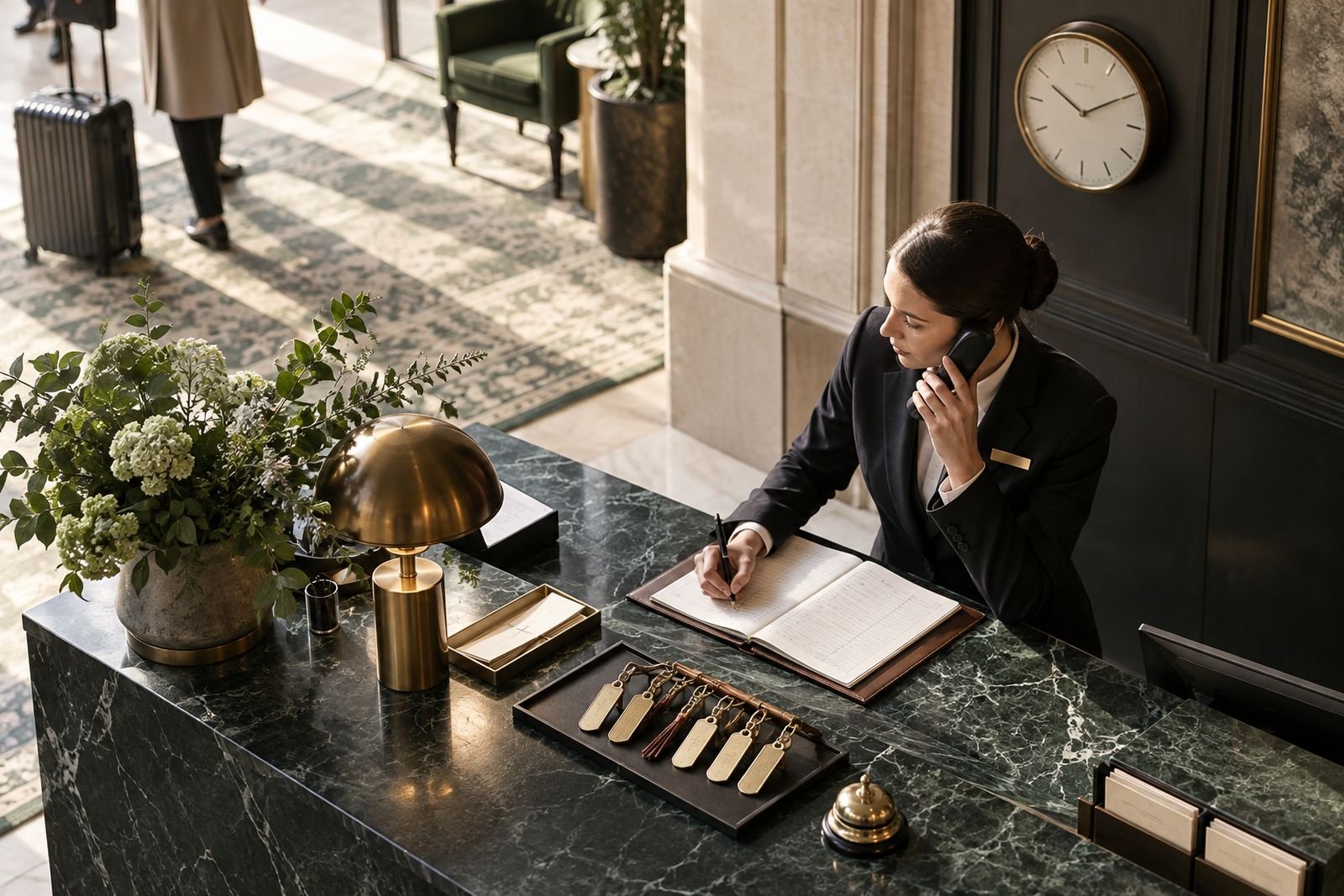
A hotel room comes with time embedded inside it. Someone cleans it, maintains it, prepares it, sells it and responds when something goes wrong. Yet the guest does not experience most of those labour hours directly. What they experience is a small and uneven allocation of human attention.
HotelData.com reported that US hotels used an average of 2.105 labour hours per occupied room in the first quarter of 2026. That is approximately 126 minutes across every included department.
126
Total labour minutes per occupied room at the all-hotel level in Q1 2026. This is not 126 minutes of direct guest contact; it is the operating envelope from which that contact is funded.
The distinction is important. Housekeeping time creates cleanliness. Engineering time creates reliability. Management time creates coordination. Only a portion becomes visible interaction: the welcome, explanation, recommendation, recovery or conversation the guest recognises as service.
A missing service metric
Hotels commonly track hours per occupied room, cost per occupied room, payroll percentage and productivity by department. These are essential cost controls. They do not answer a different commercial question: how much capable human attention does the rate actually buy?
We propose a working metric: Guest-Facing Human Minutes per Occupied Room, or GFHM. It would count direct, purposeful human time available to a guest—not incidental visibility and not back-of-house production.
The calculation can begin simply:
GFHM = direct guest-contact hours × 60 ÷ occupied rooms
A more useful version weights those minutes by role and authority. Five minutes with an employee who can solve a problem may be worth more than fifteen minutes with someone required to escalate it. Hotels can therefore separate transactional minutes, advisory minutes and recovery minutes.
Why minutes matter commercially
If two hotels sell similar rooms at different rates, the premium is often justified through service. But “service” is rarely quantified with the same discipline as room size, breakfast inclusion or cancellation terms. GFHM makes the operating promise testable.
It also helps automation decisions. If mobile check-in removes four transactional minutes, the hotel can treat that as a pure cost saving—or reinvest the time in arrival recognition, local advice or recovery capacity. The technology decision becomes an allocation choice rather than a headcount target.
01
Transactional
Identity checks, keys, payment, directions and routine requests. Highest automation potential.
02
Advisory
Recommendations, itinerary design and interpretation. Value rises with local knowledge.
03
Emotional
Recognition, reassurance and milestone moments. Difficult to standardise credibly.
04
Recovery
Diagnosis, authority and coordination after failure. High reputational value.
The wrong way to use the measure
GFHM should not become a quota that forces employees into performative conversation. More minutes are not automatically better. A guest who wants speed may value zero unnecessary contact. The objective is the right human availability for the product promise.
Nor should the metric replace labour-cost controls. It complements them. CPOR explains what labour costs. HPOR explains how much labour the operation uses. GFHM would explain how much of that capacity becomes intentional guest attention.
The comparison becomes especially useful across brand tiers. A select-service hotel may deliberately offer low GFHM and still deliver an excellent product through reliable self-service. A luxury hotel that claims highly personalised service should show a materially different allocation—or admit that the premium is being carried by hardware and branding instead.
The Leisure Economy View
How to put this to work.
Start with one week
Tag direct guest-contact time by role, divide it by occupied rooms and compare the result with guest satisfaction, recovery speed, ancillary spend and rate tier.
Do not optimise blindly
Reduce transactional minutes first. Protect advisory and recovery capacity. The goal is not maximum contact; it is maximum consequence per minute.
Sources and methodology
HotelData.com, Q1 2026 Hotel Labor Costs Report, 11 June 2026. All-hotel HPOR of 2.105, based on Actabl Hotel Effectiveness data.
Research
HotelData.com, 2025 Hotel Labor Costs & Trends Report, 12 March 2026. Full-year labour cost and productivity trends.
Research
Actabl Hotel Labor Cost Index. Relationship between HPOR, wage rate and CPOR.
Research
Disclosure: the author holds a commercial marketing role within the branded resort sector, including in Mexico. No sponsor, partner or commercial relationship influenced this piece. Every figure cited is drawn from public statements, official statistics or freely published research; no employer, subscription or otherwise non-public data was used. See our sponsorship disclosure.