No. 119 · Hospitality / Analysis
Beyond All-Inclusive: The Future of Luxury Is Not More Inclusion. It’s Less Friction.
The most elevated hospitality experiences are moving beyond unlimited consumption — and toward something far more valuable: a world that operates around the guest.
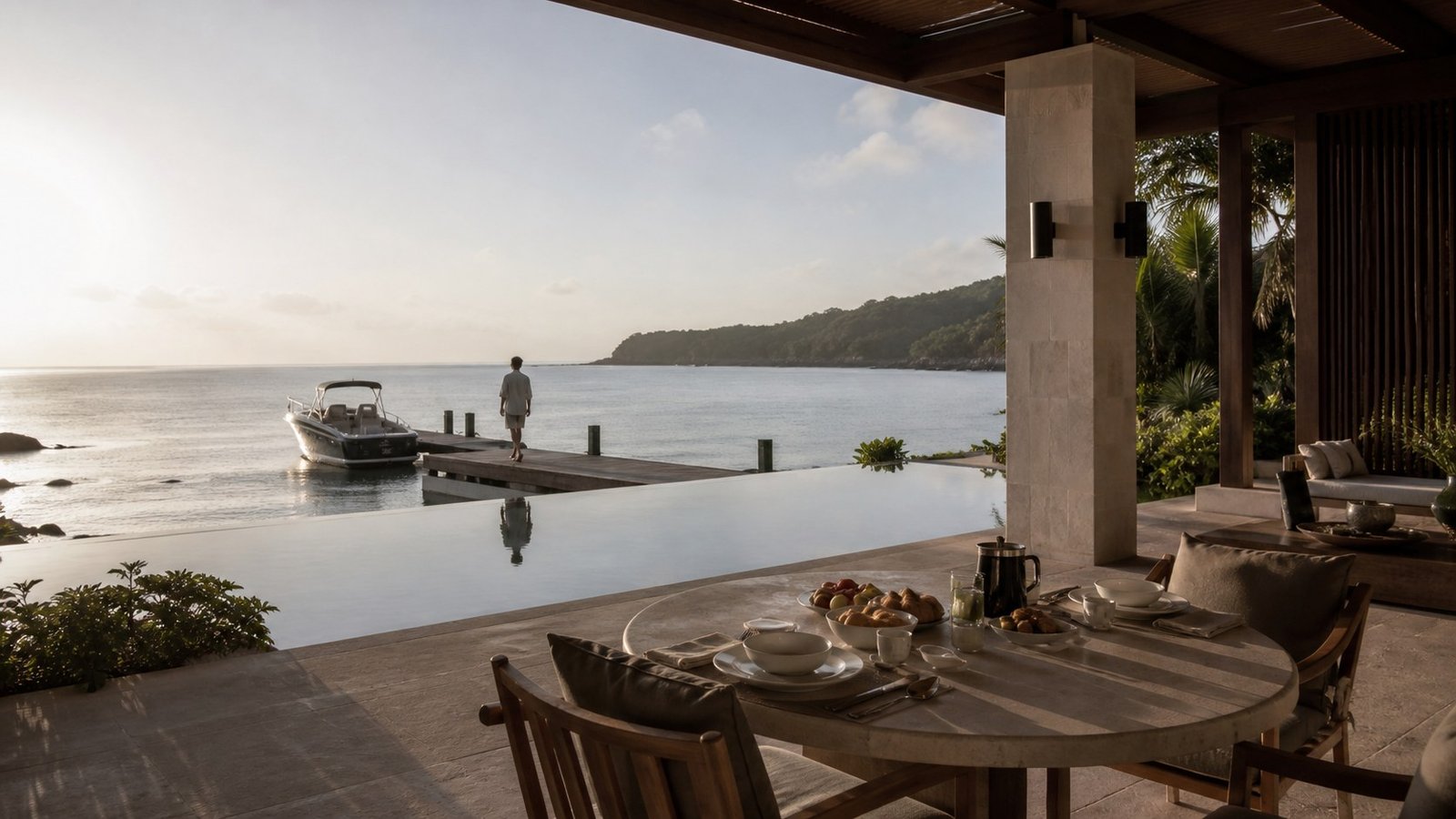
For decades, the all-inclusive proposition was brilliantly simple. Pay once. Stop thinking about money.
Meals were included. Drinks were included. Entertainment was included. The pool was there, the beach was there, and the buffet would be waiting again tomorrow morning. The model solved one of travel’s most persistent frictions — the transaction — and it worked well enough to turn a standardised vacation format into one of the most important resort models in global leisure travel.
What is striking is how the industry itself describes the appeal. Ask the people building these resorts why guests buy them and almost nobody talks about abundance. Hilton’s commercial director for the Caribbean and Latin America, Fernando Luis, puts it this way: “People love the idea of just showing up and not having to think of every step… There’s no planning, there’s no hassle.” Marriott’s development leadership in EMEA has called it “a hassle-free option with cost certainty.” Brian King, who leads Marriott’s Caribbean and Latin America business, reduced it further: “That ease of purchase and ease of business is so important to customers today.”
Three executives, three companies, and not one of them said more. They all said easier.
Which is worth sitting with, because for thirty years the category has been sold on the opposite promise. Along the way it moved dramatically upscale — buffets became à la carte restaurants, house wine became Champagne, standard rooms became swim-up suites, entertainment became curated programming. The industry called it luxury all-inclusive, and the label stuck.
But something more interesting is happening at the very top of hospitality. The most sophisticated inclusive experiences are no longer competing primarily on what is included. They are competing on how little the guest needs to think, plan, organise or manage.
That changes the meaning of all-inclusive entirely.
Five products hiding behind one word
Read the category carefully and it stops being one product. It is at least five, arranged in a ladder, and each rung removes a different kind of work from the guest.
Traditional all-inclusive
You don’t have to pay for anything. The original innovation was financial certainty: accommodation, meals, drinks and entertainment bundled into a single price, with transactions largely disappearing once you were inside the resort. Its greatest luxury was never abundance. It was predictability.
Luxury all-inclusive
Everything you consume is premium. The architecture stayed the same; the ingredients improved. Better rooms, restaurants, liquor, design, service and spas. It transformed the perception of the category without fundamentally changing how guests interact with the resort — there were still restaurant reservations, spa appointments, activity schedules, premium supplements, opening hours, and occasionally a surprisingly complicated explanation of what the word “all” actually covered.
Experiential inclusive
Everything you came here to experience is included. The hotel is not the reason for travelling. Patagonia is. The Atacama is. The lodge becomes infrastructure for reaching the destination, so guides, transport and exploration stop being ancillary services and become the product itself.
Ultra-inclusive
Ask for almost anything and we will make it happen. The constraint being removed is no longer price but structure — the schedule and the floor plan. Dinner stops belonging inside a restaurant, wellness stops belonging inside a spa, and an excursion stops needing a departure time.
The private world
For the duration of your stay, an entire environment operates around you. The unit of inventory changes. You are no longer buying a room inside someone else’s operating environment. You are temporarily acquiring the operating environment itself.
The third rung is where companies such as Explora become instructive. Its rate across eight lodges in Chile, Argentina and Peru — plus overland travesías between them — covers not only accommodation, meals and drinks but every guided exploration on the menu, in groups capped at eight, led by guides trained in the company’s own school, with national park entrance fees and airport transfers folded in. Safari lodges have worked this way for decades: &Beyond runs 29 lodges and camps alongside roughly a million acres of conservation land under management, and the daily rate covers meals, selected drinks and the guided activity that is the entire reason anyone came. Nobody flies halfway around the world to examine the minibar. They came for the lions.
The fourth rung is best captured by Kudadoo Maldives Private Island, whose promise is three words long: Anything. Anytime. Anywhere. The significant words are not the first one. They are the second and third. Those attack two of the most deeply embedded conventions in hotel operations — schedules and locations — across just fifteen overwater residences. Even here there is a rate card: private yacht charter, the owner’s wine cellar and dinner at the undersea restaurant next door sit outside the promise. “Anything” has edges. But the edges are drawn around exceptions rather than around the ordinary shape of a day.
The fifth rung arguably stops looking like an all-inclusive resort altogether. ÀNI Private Resorts operates four properties — Anguilla, the Dominican Republic, Thailand and Sri Lanka, with a fifth in Anguilla slated for 2027 — on a model of one group at a time. Each holds ten to fifteen suites for twenty to thirty guests, supported by a resident staff of twenty to thirty. Islas Secas, across fourteen islands in Panama’s Gulf of Chiriquí, hosts a maximum of thirty-two guests and publishes a full-island buyout rate of between 55,000 and 115,000 US dollars a night. In both cases the guest is not renting rooms. They are renting the operation.
The fundamental unit of inventory has changed. You are no longer buying a room inside someone else’s operating environment.
The category is already selling the answer back to itself
The most persuasive evidence for this shift is not in ultra-luxury at all. It is inside the mass-market all-inclusive resort, where the industry has spent the last few years building a second, gated product in the middle of the first one.
Look at what the upgrade actually buys. Not more food. Not more drink. Separation.
Elite Club
Launched across the Palace portfolio through 2026. At Riu Palace Aruba, reopened in July after a renovation reported at around 110 million dollars, it is a physically separated adults-only section: 31 private swim-up and pool suites, a restaurant for Elite Club guests only, and a beachfront lounge with private bar service that other guests cannot enter. Riu Palace Peninsula in Cancún reopened with 100 Elite Club rooms, sold explicitly to “guests seeking enhanced privacy.”
The Level
An adults-only enclave inside a family resort. At Meliá Punta Cana it means private check-in, a private lounge, a private pool, a private section of beach and exclusive dining — a separate hotel operating inside the perimeter of the one everybody else booked.
Premium Level
Now on 31 hotels across Mexico, the Caribbean, Central America, Spain and the Gulf. The promise is “exclusive spaces and tailored services”: private areas, flexible check-in and check-out, priority restaurant reservations. Sold on calm.
Star Prestige
Restricted pools and relaxation zones, sun terraces, custom check-in, extended checkout. Iberostar has since taken the same logic up a level, rebuilding its brand ladder as Waves, Selection and the adults-only luxury tier JOIA — moving the gate from inside the resort to the portfolio itself.
Select Collection
The upgrade buys you the other hotels: guests in Junior Suites and above gain access to the leisure, wellness and dining facilities of sister properties across the same resort complex.
Accor
The brand-level articulation, and the most honest piece of positioning in the category. Rixos calls itself a pioneer of the “All-Inclusive, All-Exclusive” concept — across 47 hotels and roughly 20,000 rooms — with adults-only pools and properties inside an otherwise family business.
Exclusive Collection
Three formats: whole luxury resorts, private villas and chalets, and “Spaces” — a walled premium enclave inside a mainstream resort. What is included is almost entirely friction removal: a dedicated concierge, butler service in villas, private transport for suite guests, priority reservations, free early check-in and late check-out.
Read that list again and notice what none of it is. Nobody is adding a ninth restaurant. Every one of these products sells the same three things: privacy, priority and space. The all-inclusive industry has spent a decade quietly discovering that its most valuable inventory is the part of the resort other guests cannot reach.
The numbers follow the logic. Club Med finished 2025 with business volume of 2.22 billion euros, up 4 percent, and an average daily rate of 241 euros, up 5 percent — rate growing faster than volume, across 61 resorts in 25 countries. In the first half of that year the Exclusive Collection grew faster than the group on both measures: business volume up 7 percent, rate up 6 percent. Chief executive Stéphane Maquaire has set out an ambition to roughly double the business by 2035, to 2.6 million guests across 100 premium resorts. Hilton, meanwhile, has signed its two most recent Mexican all-inclusive projects — Amàre Cancún with Curio Collection, 429 rooms, opening this October, and The Sens Cancún with Tapestry — as adults-only properties. The enclave has become the whole building.
The all-inclusive industry’s most valuable inventory is the part of the resort other guests cannot reach.
From more inclusion to more access
Luxury hospitality has spent decades communicating abundance. More restaurants, more pools, more room categories, more treatments, more bottles, more activities, more inclusions.
But abundance has diminishing returns. There are only so many meals someone can eat in five nights, only so many cocktails they can drink, only so many restaurants they can visit. Adding a ninth restaurant to a resort with eight excellent ones creates very little additional utility — and a great deal of additional operating cost.
Now consider the resources that remain genuinely scarce. Time. Privacy. Attention. Access. Space. Expertise. These cannot be consumed infinitely, and scarcity is precisely what makes them valuable.
Unlimited cocktails.
A boat available when they want it.
Fifteen restaurants.
A chef capable of cooking dinner wherever they want it.
A thirty-page spa menu.
A practitioner who already understands what their body needs.
Fifty scheduled activities.
A remarkable guide who can take their family somewhere few visitors ever reach.
The clearest proof that the market has understood this comes from the operator with the most to lose by admitting it. Marriott is building a luxury all-inclusive tier — a JW Marriott in Costa Rica, a Luxury Collection resort in Punta Cana, The Ritz-Carlton All-Inclusive Yanuna in the Dominican Republic due in 2027. In describing those products, the company has been explicit that dining, drinks and on-property entertainment are in the rate, while spa treatments and private dining are not.
That is a remarkable thing for an all-inclusive brand to say out loud. At the top of the category, the operator is deliberately un-including the two services where individual attention is most concentrated — because those are worth pricing separately, and because a guest who is paying for one-to-one time is not buying a buffet.
Where the money is going supports the same reading. Virtuoso, whose network of advisors books around 35 billion dollars a year, reported in August that 2026 sales were running 21 percent ahead of last year — but that bookings at hotels above 1,500 dollars a night were up 37 percent, bookings above 50,000 dollars up 47 percent, and leisure sales one to two years out up 50 percent. Its 2026 Luxe Report, drawn from more than 2,400 advisors, named “Unlimited Luxe” one of five defining trends, with 45 percent reporting more requests, and defined the modern inclusive stay as running from private transfers and Michelin-level dining all the way to resort buyouts “where chefs, wellness experts and guides are at the guest’s disposal.”
That is not a description of a meal plan. It is a description of staffing.
The macro picture points the same way. McKinsey’s 2026 consumer research found the global experiences market grew 2.6 percent between 2023 and 2025 against 0.8 percent for non-essential goods, with travel experiences specifically up 4.4 percent. Bain and Altagamma put consumer appetite for experiences outgrowing tangible goods by a factor of 1.5 in the first half of 2026, with immersive bookings up 30 percent year on year. And Deloitte found something sharper still in its 2026 summer research: the share of Americans planning a paid-lodging vacation fell to a six-year low of 45 percent, while average spending on the longest trip rose 17 percent to 4,069 dollars. Fewer travellers, spending more.
The rise of human abundance
This creates an uncomfortable idea for an industry organised around efficiency.
At the mass-market end of hospitality, operational efficiency is existential — and it is currently getting harder. Across roughly 5,000 US hotels, labour cost per occupied room in full-service properties rose only 1.7 percent in the first quarter of 2026, to 59.73 dollars. That looks like control until you see how it was achieved: room attendant wages rose 4.3 percent, and hotels absorbed it by cutting hours per occupied room by 2.3 percent and room attendant minutes per occupied room from 24.99 to 23.91. Overtime for room attendants rose 10.3 percent.
Translated: the industry is paying for wage inflation by rationing minutes of human contact per guest, and burning out the staff it has left.
Ultra-luxury moves in precisely the opposite direction. It intentionally creates inefficiency. A chef waiting to cook whenever six guests decide they are hungry is inefficient. A boat held available for one family is inefficient. A guide spending eight hours with two travellers is inefficient. Singita’s Milele villa in Tanzania sleeps a maximum of ten and includes, in the rate, a dedicated field guide, a chef, a butler and a housekeeping team — a staffed household assembled for one group at around 37,855 dollars a night in peak season.
That inefficiency is what creates the value. Private aviation is less efficient than commercial aviation. A yacht is less efficient than a ferry. A private dining room is less efficient than a restaurant. Efficiency is not what the customer is purchasing. They are purchasing control over resources.
Which suggests that one of the most important metrics in future luxury hospitality is something rarely celebrated in an investor deck: human abundance. How much capable human attention can be deployed around one guest? ÀNI’s published model — twenty to thirty staff for twenty to thirty guests — is roughly one to one. That ratio is the product. Everything else is the setting.
Sandals has done the maths in public. Chief executive Adam Stewart has described building new rooms at around a million dollars each, rising to 1.5 million for premium suites, against a Caribbean all-inclusive sector average nearer 600,000 — and targeting 300 to 350 rooms across 40 to 50 acres rather than filling the site. Twenty butler villas with private pools open at Sandals Saint Vincent this November. On the group’s 200-million-dollar Jamaica programme, Stewart’s framing was almost the thesis in one line: “dreaming bigger wasn’t about adding more.”
Luxury has always monetised inefficiency. The open question is whether the industry is willing to say so out loud.
Fewer keys, more land
If the argument is right, it should show up in what gets built. It does.
Lodging Econometrics data on the US luxury pipeline shows 88 projects and 25,666 rooms in the second quarter of 2020, against 92 projects and 21,119 rooms five years later. More projects, fewer rooms — the average luxury project shrank from roughly 292 rooms to roughly 230, a fall of about a fifth in five years. HVS put luxury development costs above a million dollars a key in 2025, with a meaningful number of projects clearing two million.
Those two facts sit in obvious tension. A hotel built at a million dollars a key running at 65 percent occupancy needs something close to a 1,000-dollar average rate to work. US luxury ADR was averaging around 394 dollars through September 2025. The arithmetic only closes if the building is smaller, the land is larger, and the guest is buying something other than a room.
Aman has been operating on that logic for thirty years. Its chief executive Vladislav Doronin has put the number plainly: the group’s resorts average about 35 keys, and its city hotels fewer than 90 — “still considered very small in the segment.” Amangiri sits at 34 suites on 600 acres. NIHI Sumba is 27 villas on 567. The land is not a setting for the hotel. It is most of what the guest bought.
The comparison classes tell the same story. Business jet departures rose about 4 percent in the first half of 2026, but almost all the growth was in fractional programmes — up 11.5 percent, and now more than a fifth of all business jet activity — while branded charter fell 3.1 percent and corporate flight departments fell 8.9 percent. Growth is concentrated in the models that guarantee access rather than sell a trip. In yachting the pattern is starker: charter departures in the second quarter of 2026 rose about 40 percent and booked market days rose nearly 43 percent, while the number of bookings fell 5.5 percent. Fewer charters, held longer. On the brokerage side, 8 percent fewer yachts sold for 15 percent more money.
Every one of those markets is doing what the luxury hotel pipeline is doing: shrinking the unit and raising the price of controlling it.
When the destination becomes the resort
There is a second shift running alongside the first: the physical boundary of the hotel is dissolving.
Islas Secas is not selling a luxurious room on a private island. It is selling fourteen islands, a privately funded marine protected area next to the UNESCO-listed waters of Coiba National Park, and an operation running on solar power with its own conservation foundation attached. Explora’s lodges make little sense without the territories that surround them. Safari extends the hospitality experience across thousands of hectares of wilderness. Brush Creek Ranch in Wyoming turns 30,000 acres into a single leisure ecosystem across four properties, with lodging, meals, drinks, gratuities, taxes and two daily activities inside one rate — a cap, stated plainly, which is itself a piece of honest product design.
In each case the hotel is not the entire product. The hotel is the operating system through which the destination becomes accessible.
The industry is beginning to name this. In December 2025 Marriott introduced St. Regis Estates, a brand extension built specifically for large-acreage, estate-style properties, starting with the conversion of a California resort for 2027. Rosewood publishes formal buyout programmes for properties including its 6,000-acre New Zealand lodge. These are not amenity decisions. They are a recognition that the land, the water and the access are the inventory, and that guests do not experience destinations according to property boundaries. They experience ecosystems — the beach, the ocean, the mountain, the city, the food, the people, the culture.
The hotel capable of orchestrating those elements becomes more valuable than the hotel merely containing the greatest number of amenities.
Cognitive relief may be the new luxury
There is another scarce resource hospitality rarely discusses: mental bandwidth.
Modern travellers arrive with extraordinary access to information. They can research three hundred restaurants, compare forty excursions, read a thousand reviews, build itineraries, reserve tables, coordinate transport, buy tickets, compare prices, confirm bookings, download apps — and repeat the entire process every time something changes. Technology gave travellers unprecedented control. It also quietly turned them into their own travel agents, concierges and operations managers.
The evidence that this has become a problem is now unambiguous, and it comes with a price tag attached.
The cost of planning friction
A Travelport survey of 1,000 US adults in mid-2026 found 69 percent feel overwhelmed by online travel options at least sometimes, and 36 percent always or often. 46 percent had abandoned a booking because it was too complicated or time-consuming. And 38 percent said the single thing that would improve booking a flight is fewer options.
Chase Travel, surveying more than 4,000 travellers in early 2026, found 44 percent feel more overwhelmed by trip planning than they used to — and of those, 49 percent downgraded their trip, 37 percent postponed it and 23 percent cancelled it outright.
Friction is not a satisfaction problem. It is revenue leaving the category before anyone has checked in.
People are responding by outsourcing the work. Chase found 60 percent of Gen Z and millennial travellers want to use a travel advisor. MMGY reports that 52 percent of active leisure travellers have now used AI to plan a trip, up ten percentage points in a year — and yet a separate 2026 survey of AI users, commissioned by the tour operator ALG Vacations, found 77 percent still rely on a human for the final decision, with advisors most preferred precisely for complex and high-cost trips. Travellers will let a machine narrow the field. They still want a person to take responsibility for the answer.
The major operators are spending accordingly. Marriott is three years into a roughly one-billion-dollar replacement of its reservation, property-management and loyalty systems — retiring a property system after 42 years — and the benefits its technology leadership describes are almost entirely friction: choosing a specific room, guaranteeing that a requested crib actually arrives, and bundling spa, dining and transport into a single checkout. It launched a conversational search layer, Ask Bonvoy, in June 2026. Club Med now runs an AI assistant across 18 markets handling around 30 percent of customer interactions, roughly half of them fully automated.
Note what that automation is for. It is not replacing the butler. It is clearing the queue of transactional questions so that human attention can be spent on the things only humans can do. The machine handles the friction; the person handles the guest.
Which is the whole argument in miniature. The resort already knows. The table is already reserved. The driver is already waiting. The guide understands what interests you. Your dietary preferences travelled from breakfast to dinner without needing to be explained again. And tomorrow has somehow organised itself.
This isn’t personalisation. It is cognitive relief — and it may become luxury travel’s most valuable product.
The paradox of choice in luxury hospitality
Hotels have historically equated choice with luxury. Five restaurants are better than two. Twelve pillow options are better than three. Thirty spa treatments are better than ten. Seventy excursions are better than twenty.
The Travelport number breaks that assumption cleanly. When asked what would most improve the experience of booking, the largest identifiable group of travellers did not ask for more inventory, better filters or lower prices. They asked for fewer options.
Because choice creates work. Someone must compare. Someone must select. Someone must reserve. Someone must coordinate. Someone must worry about making the wrong decision on a holiday that cost a great deal of money.
So the highest form of hospitality inverts the equation. Premium hospitality provides excellent choices. Luxury hospitality increasingly provides excellent judgment. That is far harder to build than another restaurant, because it requires actually understanding the guest — not demographic personalisation, not “Mr Smith stayed with us before,” but contextual intelligence. Why are they travelling? Who with? How much energy do they have today? What have they already experienced? What do they dislike? What would surprise them? What do they not yet know they would enjoy?
When hospitality answers those questions well, personalisation stops being a CRM function. It becomes curation.
Soneva is unusually honest about what that costs. Its Unlimited plan — the top tier above breakfast, half board and full board across its Maldives resorts — is priced as a per-person supplement on top of the villa rate: 1,250 dollars per adult and 625 per child, per night, for the 2026 season. It makes visible what most inclusive pricing is designed to hide. Inclusion is not a gift that arrives with the room. It is a product with a cost, and someone is paying for it either way.
The private world becomes an asset class
The clearest signal that this is a structural shift rather than a marketing cycle came in December 2025, when Exclusive Resorts, onefinestay and Inspirato were brought under a single owner — The Exclusive Collective, majority-owned by Steve Case — projecting more than 500 million dollars of revenue and around 70 million in EBITDA for 2026 across 25,000-plus high-net-worth travellers.
Its chief executive, James Henderson, described the founding philosophy in terms that could serve as this article’s subtitle: a business “centered on how people choose to spend their most finite resource: time.”
The economics underneath are instructive. Exclusive Resorts charges an initiation fee of between 195,000 and 295,000 dollars and, for 2026, annual dues of 1,835 dollars per Plan Day — consistent across all seasons, locations and residence sizes. That flatness is the product. There is no peak-season surcharge to evaluate, no comparison to run, no decision to regret. Members get roughly 400 residences across 75-plus destinations with daily housekeeping and an on-site team included.
Inspirato, taken private in February 2026 at a 59-million-dollar equity value, shows the other side of the same trend: in its last public quarter it reported around 10,700 memberships and an average daily rate of 1,742 dollars, up 20 percent year on year — after a full year in which total revenue had fallen 15 percent. Fewer members, paying considerably more. And onefinestay, now inside the same group, spent April 2026 transferring more than 200 London and Paris homes to another operator in order to keep about 40 curated London properties — deliberately shrinking to concentrate at the top.
Three companies, one owner, and the same instinct in each: fewer customers, more attention, higher price.
Seven brands showing where the category could go
ÀNI Private Resorts turns the resort into a private operating environment dedicated to one group at a time. Kudadoo Maldives Private Island pushes inclusivity toward freedom of time and place rather than freedom of quantity. Soneva shows that abundance can exist at the ultra-luxury end without adopting the visual or cultural codes of all-inclusive — and prices it transparently. Islas Secas folds access to an extraordinary marine ecosystem into the hospitality proposition itself. Explora makes exploration a fundamental component of the stay rather than an upsell. &Beyond and the leading safari operators have understood for thirty years that guests are not buying rooms but privileged access to extraordinary places. And Brush Creek Ranch demonstrates a fourth variation: a private leisure ecosystem where land, activities, gastronomy, wellness and expertise operate as one system.
These businesses look nothing alike. A Maldivian private island has little visually in common with a Patagonian lodge or a Wyoming ranch. Strategically, though, they share the thing that matters. None of them is primarily selling accommodation. All of them are selling access to a controlled ecosystem of experiences.
Where the argument is weakest
Three cautions are worth stating plainly, because the case is stronger with them than without.
First, the luxury spread is real but not universal. CBRE’s August 2026 forecast has US luxury RevPAR growing 5.2 percent this year against 0.7 percent for midscale and minus 0.6 percent for economy, and the same gap shows in the operators’ own reporting: Marriott’s luxury RevPAR ran above 9 percent in the US and Canada in the second quarter against 3.4 percent worldwide, and Accor’s luxury and lifestyle division outpaced its premium, midscale and economy division in the first. But Hilton’s Chris Nassetta argued in April that the market is not K-shaped at all but “C-shaped,” with demand spreading across the income spectrum rather than concentrating at the ends. Deloitte draws the line in a different place again: ultra-luxury looks insulated, while mid-market luxury — rates under 500 dollars — may soften in 2026. The shift is not luxury pulling away from everything. It is the top of luxury pulling away from the rest of luxury.
Second, nobody publishes a benchmark for this category. There is no all-inclusive chain scale in the standard industry data, no independent series for resort buyouts, no audited index of staffed-villa demand. The best available proxy — Caribbean hotel performance, where occupancy ran 73.4 percent and RevPAR was up 11 percent through July 2026 — covers the whole region, not the segment. Anyone claiming a precise all-inclusive rate premium is estimating.
Third, scale still works. Marriott has grown to 38 all-inclusive resorts across nine markets with another 16 properties and roughly 5,600 rooms in its Caribbean and Latin America pipeline, and it got there largely by converting other people’s hotels — 19 resorts and about 7,000 rooms arrived in a single 2021 transaction. Brian King’s observation that some of these resorts run at 90 percent occupancy is not a footnote. The conventional model is not collapsing. It is being out-priced at the top by a version of itself that has stopped competing on volume.
A different definition of all-inclusive
Perhaps the category has been defining its own word incorrectly.
“All” does not have to mean everything you can consume. It could mean everything required to experience this place exceptionally well.
That single substitution changes product design, staffing models, pricing architecture, resort layout, partnership strategy, technology investment and the way destinations are incorporated into hospitality. Most importantly, it changes what the guest is actually buying.
Beyond all-inclusive
At the top of the ladder, something fascinating happens: the institutional structure of the hotel begins to disappear.
There is no restaurant reservation, because dinner happens wherever you want it. There is no excursion departure, because the boat leaves when you are ready. There is no spa appointment, because wellness comes to you. There is barely a traditional check-in, because the property already knows who is arriving.
The guest stops navigating the hotel. The hotel starts navigating the guest.
And that may be the real destination of luxury all-inclusive. Not more food. Not more drinks. Not more restaurants. Not even more inclusions. Something considerably harder to deliver: less friction.
Because perhaps the ultimate luxury is not having everything included. It is never having to ask what is.
The Leisure Economy View
What this means for operators, investors, marketers and destinations.
For operators
Audit your inclusions for utility, not volume. Anything a guest cannot realistically consume in five nights is a cost you carry and they do not value. The industry is already rationing minutes of human contact to pay for wages — decide deliberately which guests you spend those minutes on, rather than letting the labour model decide for you.
For investors
Ask what a property can guarantee, not what it can list. Amenity counts are copied in a season; staffing depth, protected land, marine access and exclusive-use inventory are not. Watch two lines in particular: recurring access or membership income, and key count relative to site area. Both are now moving in the same direction.
For marketers
Stop selling the inventory list. Nearly four in ten travellers say fewer options would improve the experience. The persuasive claim at the top of the market is specificity about what is guaranteed, for whom, and when — and it is only worth making if operations can keep it.
For destinations
Friction is a destination attribute. Airlift reliability, transfer times, permit access and protected natural assets set the ceiling on what every operator in the market can charge. Where the territory is the product, conservation is not a CSR line. It is inventory management.
Sources and methodology
This thesis draws on published market research, company reporting and earnings commentary, and operator-published rate and inclusion documents. Brand and figure details were verified against primary sources in August 2026. Rates reflect the most recent published season and should be treated as indicative rather than current at time of reading. Where an independent benchmark for the all-inclusive segment does not exist, that is stated in the text rather than estimated around.
CBRE Hotels Research — 2026 US RevPAR forecast by chain scale
Research
Lodging Econometrics US luxury pipeline data and HVS 2025 development cost survey, via HOTELS Magazine — project counts, room counts, cost per key
Research
Travelport / Dynata, 1,000 US adults, June 2026 — booking overwhelm and abandonment
Research
Chase Travel, 4,076 travellers, January 2026 — planning fatigue and its downstream effect on bookings
Research
Virtuoso network sales data, August 2026 and the 2026 Virtuoso Luxe Report — booking growth by rate band; “Unlimited Luxe”
Research
McKinsey State of the Consumer 2026, Bain & Company / Altagamma and Deloitte 2026 summer travel research — experiences versus goods; trip frequency versus spend
Research
HotelData.com Q1 2026 Labor Costs Report (Actabl, ~5,000 hotels) — labour cost per occupied room, hours and minutes per occupied room, wage growth
Research
Company reporting and executive commentary: Marriott International (Q2 2026 results and earnings call, CALA and luxury development releases, St. Regis Estates announcement, Ask Bonvoy launch), Hilton (Q1–Q2 2026 results, CALA commentary), Accor (Q1 and H1 2026), IHG (H1 2026), Club Med (FY2025 and H1 2025 results), Sandals, Meliá, Iberostar, RIU, Barceló, Palladium
Public
The Exclusive Collective and Inspirato transaction and results releases; Exclusive Resorts published membership terms
Public
Operator-published material: ÀNI Private Resorts, Kudadoo Maldives Private Island, Explora, Islas Secas, Soneva, &Beyond, Brush Creek Ranch, Singita, Aman — inclusions, capacity and published rates
Brand
WINGX business aviation data (H1 2026) and Northrop & Johnson Q2 2026 superyacht market report — fractional and charter demand
Research
STR Caribbean hotel performance via Caribbean Journal, and author observation across inclusive and ultra-luxury resort operations in Mexico, the Caribbean and Latin America
Field
Disclosure: the author holds a commercial marketing role within the branded resort sector. No sponsor, partner or commercial relationship influenced this piece, and all company figures cited are drawn from public filings, published research or operator-published material. See our sponsorship disclosure.